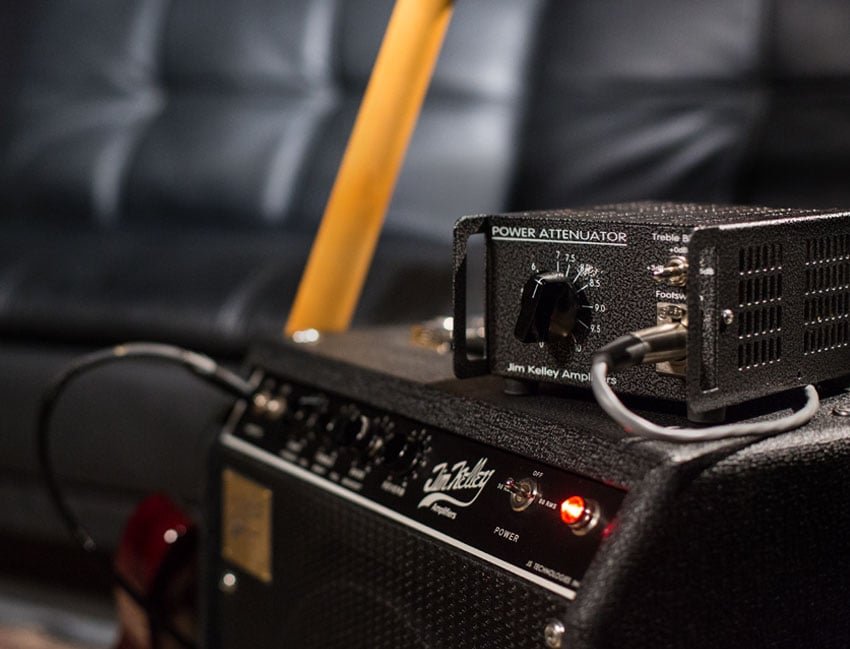
Final Production Run!
Power Attenuator
Jim Kelley Amplifiers™ Power Attenuator
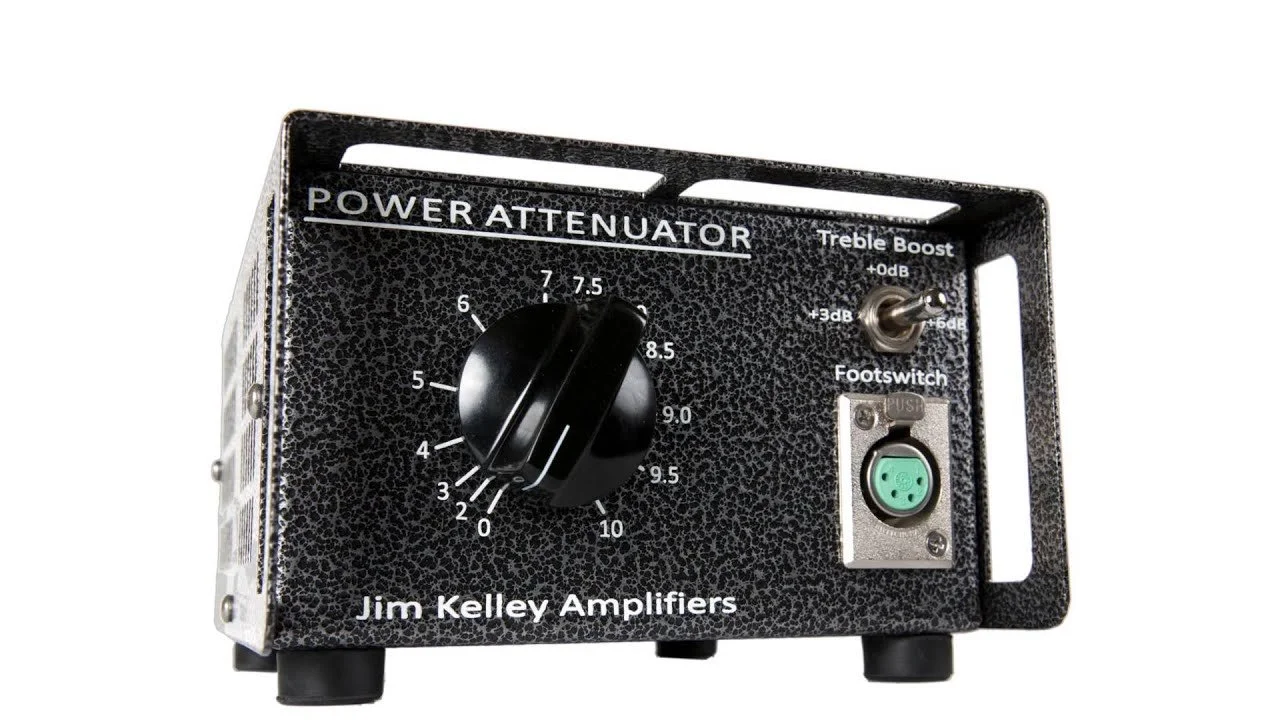
Genuine Ohmite rheostats, Switchcraft connectors, Dayton capacitors, and Darling switches
Original clarity and purity of tone - with Loudness Compensation
16 Gauge steel chassis with front panel guard
New amplifier footswitch interface jack for Channel Switching or Gain Boost
Maximum Power Input: 100 Watts
PURCHASE
$1400.00 Includes attenuator and footswitch
$1250.00 Includes attenuator and dongle
To purchase make payment to paypal.me/JimKelleyAmplifiers.
In paypal notes include address, shipping information, and contact information.
For questions contact Jim Kelley at jimkelleyamps@gmail.com.
Treble Boost (Loudness Compensation)+6dB @ 10 KHz,@ 8.25 dB attenuation
+3dB @ 10 KHz @ 8.25 dB attenuation
Line Out
Source Impedance: ~200 ohms
Voltage Attenuation Ratio: ~10:1
True Bypass Footswitch
Attenuator must be used with either a footswitch or 4-pin mating plug
INSTRUCTIONS
Use a short ¼” speaker patch cord (not coaxial) to connect the speaker jack on the amplifier with the ‘Amp’ connector on the back of the attenuator. Connect the cable from the speaker or speaker cabinet to the ¼” jack marked ‘Speaker’ on the back of the attenuator. Connect the 4-pin footswitch cable to the XLR jack on the front panel of the attenuator. Do not use the amplifier without all of these cables connected to the attenuator. If you’re using the auxiliary switching jack, and the amp is attenuated in the opposite mode, remove the bottom of the footswitch and slide the selector switch to its other position.
Shipping Weight: 8 lbs
Dimensions: 6” wide, 4” high, 7” deep
Definition: Power Attenuator
An infinitely variable power absorbing device that allows your amp to breathe and your guitar to sustain. The ultimate volume control.
The Jim Kelley Power Attenuator is designed to allow you to turn your amp up so it can achieve its best tone, while the Power Attenuator maintains precise control of your volume.
The L-Pad Attenuator
The Jim Kelley Power Attenuator utilizes a time-proven engineering standard L-Pad design. An L-Pad is an infinitely variable power divider that, when combined with a speaker, maintains constant load impedance over its range of adjustment. L-Pads have been used to adjust the volume of high fidelity music systems with complete transparency for more than 50 years. At the heart, of our device is a pair of 100 watt rheostats wired in an ‘L’ arrangement. A rheostat is a large, power dissipating, wirewound potentiometer. Increasing the amount of attenuation moves the rheostats in unison such that as the impedance of the series rheostat increases, the impedance of the shunt rheostat decreases. As attenuation is increased, more power is diverted to the rheostats and less is conveyed to the speaker. Maintaining constant load impedance at all attenuation settings allows the natural tone of your amplifier to come through at virtually any power level. This is a rugged, good looking, high power device with more than 30 years of performance tested experience on stages around the world.
Resistance vs. Reactance
There are two perspectives from which to view impedance: from the perspective of the amplifier, and from the perspective of the speaker. Generally, the perspective of the amplifier is taken, and it is argued that in order to best preserve the integrity of the signal, the attenuator should present a reactive load to the amplifier. This has the effect of shaping the frequency response. However, from the perspective of the speaker, the way it responds to a given signal is primarily a function of its own frequency-dependent impedance characteristics. With a reactive attenuator, the frequency response is a combination of both the response of the speaker and the response of the attenuator. The logic for using purely resistive elements in the attenuator is that they are neutral with regard to frequency, and can thus provide optimal signal transparency. Although there are other effective means for accurately attenuating a signal, and some may be well suited in a bedroom environment, players have found that ours is simple, practical, reliable, and great sounding on stage and in the studio.
The ‘Loudness Effect’
Ever notice what happens when you listen to music at low volume? The high-end and low-end become less prominent. Stereo systems have a Loudness switch to compensate for this, and now due to popular demand the Jim Kelley Power Attenuator also has 3 levels of Treble Boost compensation: 0dB, +3dB, or +6dB. The exact amount of compensation varies as needed with the amount of attenuation. Webster’s dictionary defines dynamic range as the ratio of the strongest to the weakest sound intensity reproduced by an audio system. Turning down the volume on your stereo reduces the dynamic range of the sound by reducing the strongest sound intensity. This is what a volume control does - the advantage of using a power attenuator is that it allows you to utilize your amplifier to its full capacity.
The Footswitch
True bypass footswitching allows you to restore full power in an instant. With the Jim Kelley Power Attenuator you can adjust for both a clean sound, and an overdriven output sound - both at the same volume. An internal selector switch allows you to optimize the auxiliary switching for your particular amplifier.
Attenuator Demos
I talked a friend of mine, Jake Hill into working with me at his home studio. We set up his Marshall head and an attenuator in the control room with us, and we miked a 2x12 open back Marshal cabinet out in the studio. In the first sound file, I adjust the attenuator from all the way up, to all the way down, and back again, while narrating.
In the second sound file, we keep the recorded levels constant at different attenuators settings, making for a simpler tone comparison. We recorded the same Marshall/’63 Strat setup as before, first with the attenuator at full; then at ‘7’, ‘5’, and ‘3’. Only the Power Attenuator setting and the mic gain were changed so that we could maintain a constant level on the track. The equalization and dynamics were not altered so you can compare the recorded sound at different levels of attenuation. The results are impressive. Special thanks to Jake Hill.
The Power Attenuator is a sonically transparent means for controlling power.